
Target Challenge
We want to thank you for purchasing your D-Vise and we’re confident that it will make a significant improvement to your rifle’s precision. Most companies that make accuracy or precision claims don’t do anything to back up their claims. Not us. We wanted to provide you with a way to see how much of an improvement the D-Vise makes on your rifle so we came up with the Target Challenge. If you’re happy just installing the D-Vise and going with it, more power to you. But, if you want to know how effective the D-Vise is on your rifle, then read on.
The Target Challenge is our method of measuring and comparing rifle precision before and after the D-Vise is installed. It is designed to evaluate how well your rifle shoots before you’ve installed the D-Vise and compare it to after you’ve installed the D-Vise, to do so in a statistically valid way, and to do it with only 20-40 shots in most cases. It is a mathematically rigorous and statistically valid method, but it’s probably different than what you’ve seen before so read below to get a basic understanding of how it works. We’ve made this a simple process for you to do. All the math is being done for you in the background so all you have to worry about is shooting the rounds and entering that data. The results are calculated automatically and presented to you as a summary.
Accuracy vs Precision
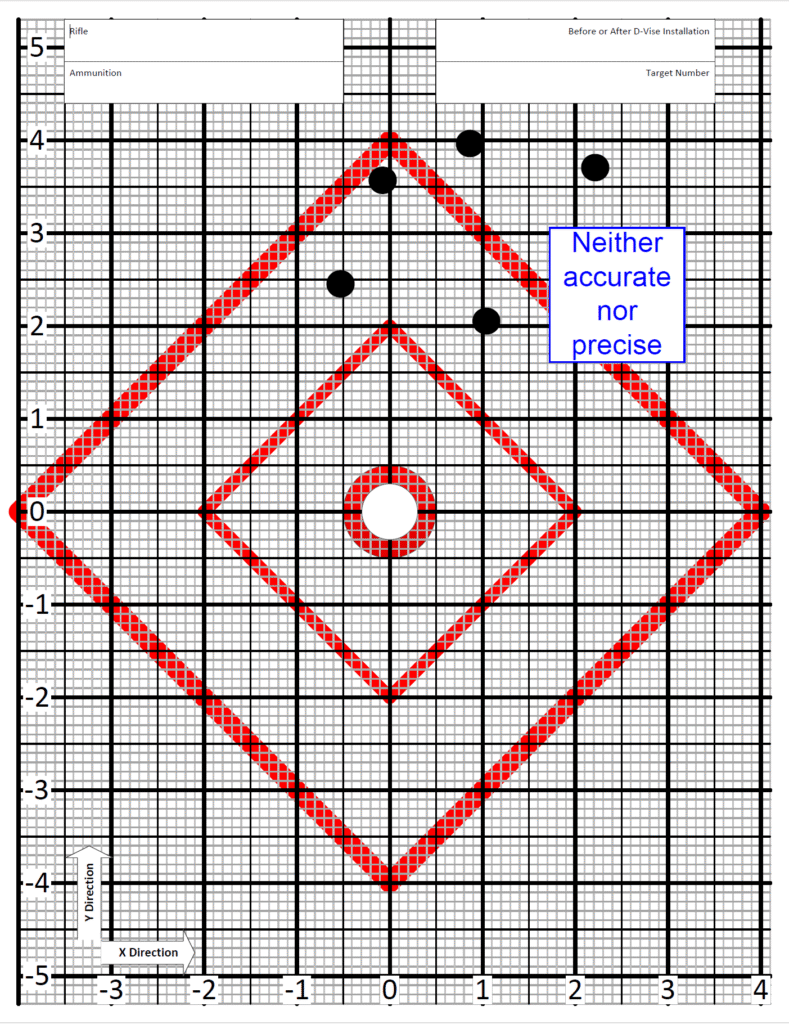
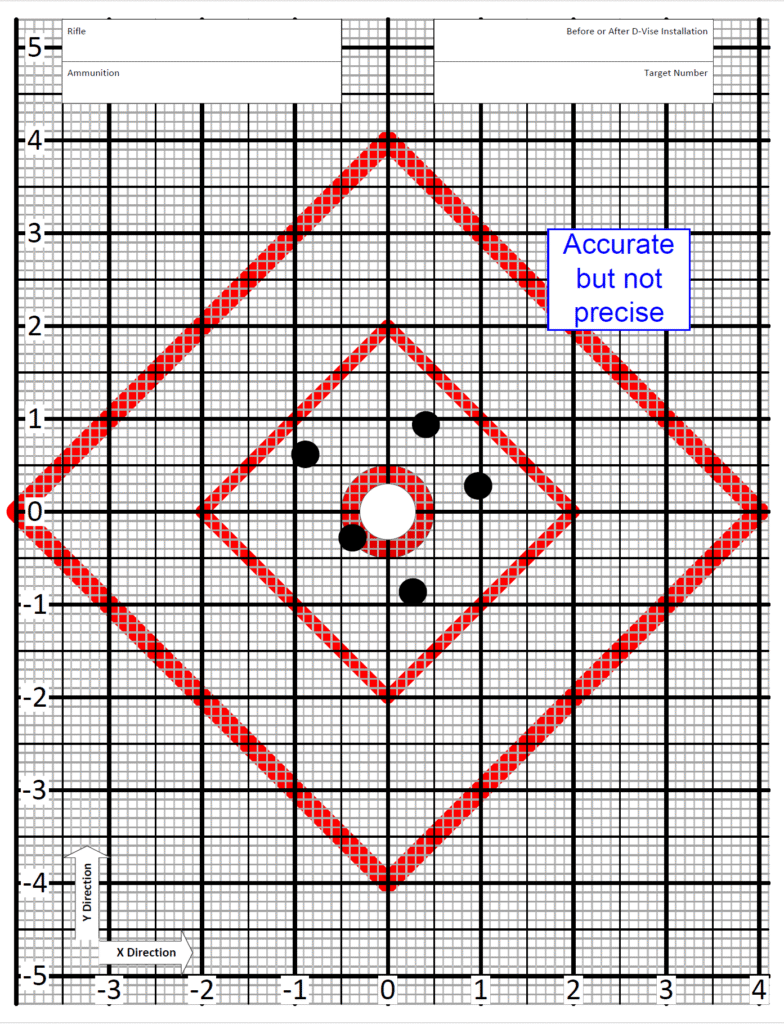
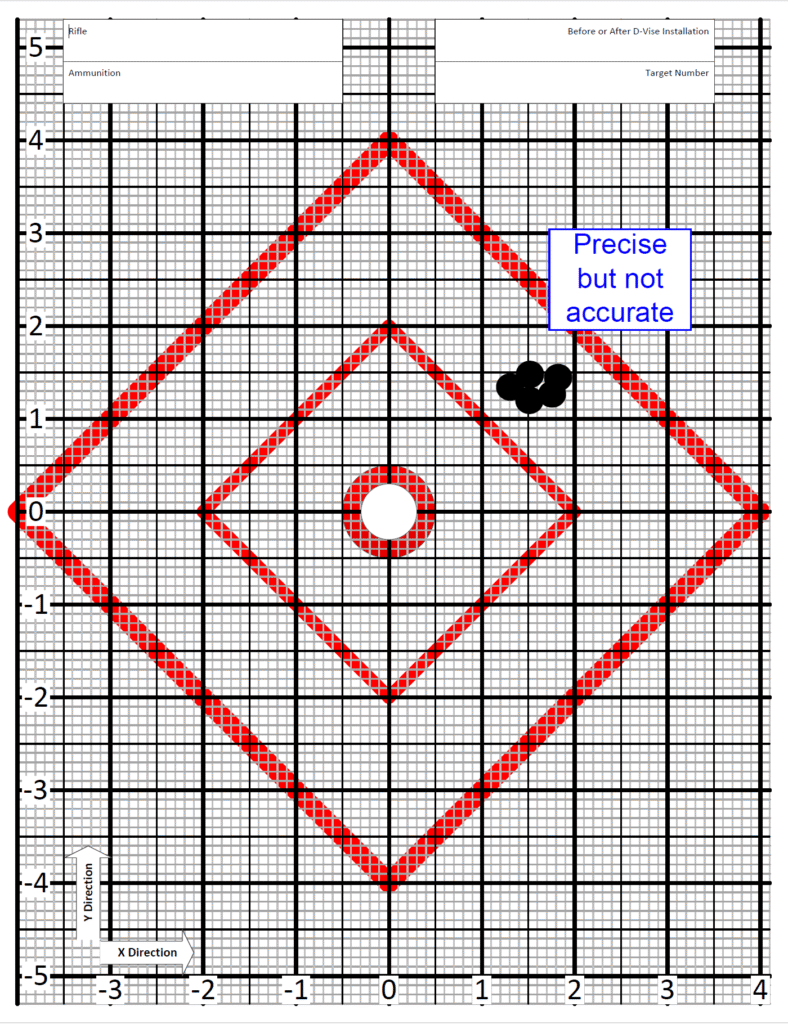
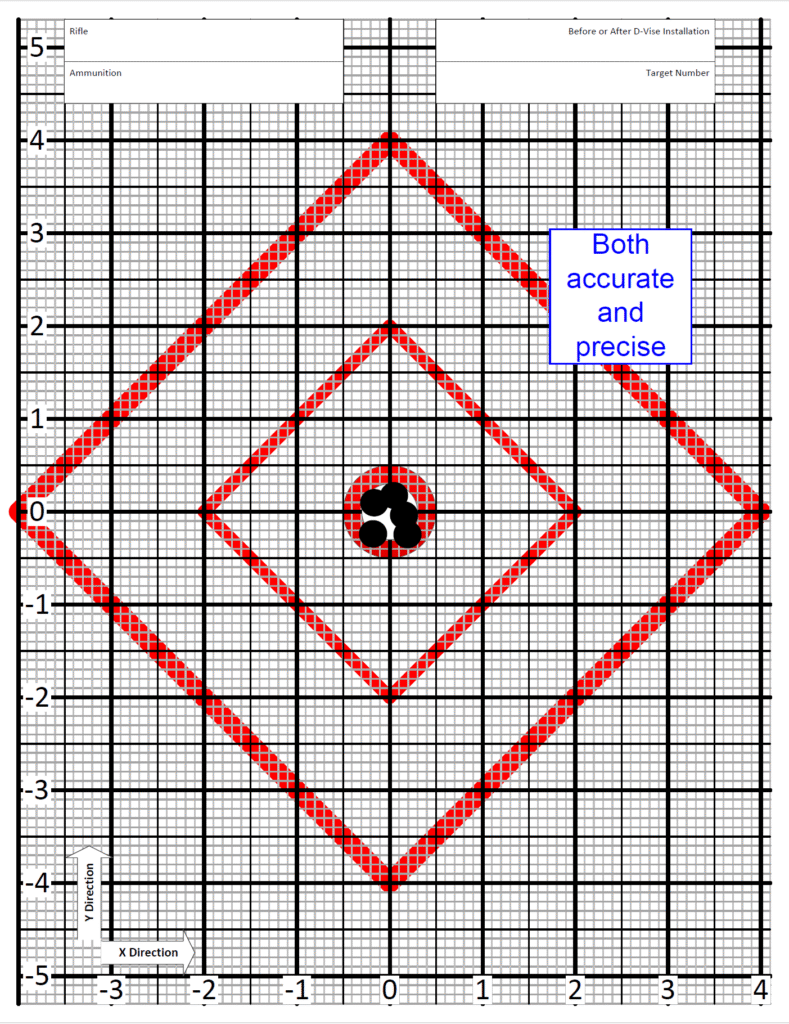
Most people use accuracy and precision interchangeably, but really they are two different things. What you’re after with your rifle is both and the Target Challenge will help you with both. The four pictures below illustrate accuracy vs precision.
The D-Vise will improve your rifle’s precision and the shot data you gather in the process of measuring the precision will also show you how to adjust your scope for accuracy.
The Statistics of Shot Dispersion
We all want to know how small of groups our rifle will shoot and how to properly zero our scope to put rounds in the bullseye as often as possible. But how do we go about that? When we talk about group size, we’re really talking about precision or bullet dispersion. That is, how much our bullets spread out on the target. When we talk about hitting the bullseye, we’re really talking about accuracy or where the center of the dispersion is located. Properly zeroing your scope requires knowing the center of your rifle’s dispersion as closely as possible. So, how do we determine the dispersion and the center of dispersion?
The most common way people measure shot dispersion is to measure the extreme spread of a 3 or 5 shot group. That’s an easy, field expedient method, but unfortunately it’s almost completely useless. Now before you call BS, let us explain.
The biggest problems with measuring group size are (1) it tells you something about precision but almost nothing about accuracy, (2) it requires 3 to 5 shots to get a single piece of data, and (3) people usually don’t shoot enough groups to get a good idea of the real precision of the rifle. Shooting just one group or even a few groups just simply is not a large enough sample size to capture normal variation. Don’t believe us, go out and fire 10 or more groups and see what your get. We hate to tell you this, but to get a meaningful measure of your rifle’s precision and accuracy you need 10 data points at an absolute minimum. So if you’re shooting a 3 to 5 shot group to get one data point, that’s 30-50 rounds. And 20-30 data points is much better, meaning 60-150 rounds. To compare before and after some change means double that. Yeah, that’s 60 rounds minimum and up to 300 rounds to evaluate if a change you made had a real effect or not. That sucks for sure. Basically you’re spending a lot of money and a lot of time to get very little information and you may not even be getting some of the most important information, namely how to properly zero your scope.
It would be much better to use a method where every shot gives you useful data about both precision and accuracy. The Target Challenge does exactly that using a little bit of statistics and compares before and after the D-Vise is installed with usually only 20-40 rounds total, or 60 rounds total if you really want to be confident in the result. This method tells you what you should expect for precision (group sizes) and accuracy (group location or how to properly zero your scope) from your rifle.
Statistics is basically the math of probability, or variation, or dispersion, or uncertainty. It applies perfectly to evaluating how well your rifle shoots. So, here we go with a little bit about statistics.
The Normal and Chi-Squared (C2) Distributions
Oh yeah… We know a lot of people just tuned out. But hang in there for just a moment. We’ll keep it simple. These are probability distributions that are very common in statistics. We’re just going to touch on the basics because they are critically important to evaluating precision and accuracy. Don’t worry, you won’t need to do the math.
The normal distribution is the classic bell curve. It’s called “normal” because it describes how most variation normally occurs. It uses two terms: the average (also called the mean), and the standard deviation. The average can be any value, positive or negative. The standard deviation describes the spread. The mean plus or minus one standard deviation contains 68.2% of the data. The mean plus or minus two standard deviations contains 95.4% of the data. And the mean plus or minus three standard deviations contains 99.7% of the data. Notice that the spread gets a lot wider to capture that last 4.3% going from 95.4% to 99.7%. For this reason, plus or minus two standard deviations, or 95.4% of the data, is often the most useful.
When you shoot a number of rounds at a target, the dispersion in the horizontal and vertical directions (or any direction) is generally going to be normally distributed. The Target Analysis spreadsheet will check to make sure this is the case when it evaluates your shot groups. The center of the group is located at the average value in the horizontal and vertical directions. The standard deviation in the horizontal and vertical directions is directly related to the mean radius, which we will get to in a moment.
The chi-squared (C2, Greek capital letter C) distribution is what you get when data cannot have negative values. In the case of a number of shots fired at a target, the distance from the group center to each shot always has a positive value so it follows the chi-squared distribution. The main thing we get from the chi-squared distribution is what is called the mean radius. This is the average distance of all the shots from the center of the group. This is an especially important value because it basically tells you everything about the precision of your rifle including your average group size.
So, if we know that the horizontal and vertical dispersion are normal, then we know where the group center is located and that the distance of the shots from the group center follows the chi-squared distribution. We can then calculate a valid value for mean radius. From this information, with a bit of math, we can now determine a number of things such as:
- The average group size for 3 shot groups, 5 shot groups, or any number of shots in a group.
- How likely you are to put all the shots of any group into the bullseye. (Unfortunately, it’s not as likely as you might think. Good thing you bought a D-Vise.)
- The size of a circle that will contain any given percent of all your shots. For example, the size of the circle that will contain 95% of your shots.
- How to adjust your scope so that it is correctly zero’d and you are not having to second guess the adjustment all the time.
The Statistical Concept of Confidence and How Many Rounds to Shoot
Without going into any math, the statistical concept of confidence refers to how likely it is that the statistical results you get from your data are giving your the correct conclusion or the wrong conclusion. The key concept here is that the more data you get, the more certain you are that the results are true and correct rather than an error by random chance. This is important to consider when deciding how many rounds to shoot before and after installing the D-Vise.
At a minimum you should fire 10 rounds before installing the D-Vise and 10 rounds after. This is often enough to show that the improvement in your rifle’s precision is real and not a fluke of random variation. However, this few of rounds will result in a relatively large uncertainty compared to shooting 20 or more rounds before and after installation.
Shooting 20 rounds before and after the D-Vise installation is much more likely to give you a result that has high confidence. This is the number or rounds we generally recommend for most cases.
If you want to be highly confident in your results, shooting 30 rounds before and after the D-Vise installation is almost always sufficient.
This also leads to the “confidence window” on results. For example, the group center location is average values in the horizontal and vertical directions on the target. But, this is based on the number of shots you took and how they are spread out. This means there is a possibility that the center location based on the sample data is not the true location that you would get if you fired every single round that your gun will ever fire. The confidence window is the center location plus or minus a certain amount that equates to a confidence (usually 95%) that the true center is within the window. So, expect the center location to be at the location calculated, but it could be off a little bit as shown by the confidence window. The more rounds you shoot, the smaller the confidence window will be. This applies to your group sizes the same as it does to center location.
The table below provides some guidance for choosing how many rounds to shoot. Be aware that a confidence value of 100% is not exactly 100%. Statistically, 100% confidence does not exist. But if it is over 99.5% it is displayed as 100% due to rounding.
|
Rounds |
Percentage of group size reduction |
|||||||
|
10% |
15% |
20% |
25% |
30% |
40% |
50% |
75% |
|
|
10 |
71% |
76% |
80% |
84% |
87% |
92% |
96% |
100% |
|
15 |
76% |
81% |
86% |
90% |
93% |
96% |
99% |
100% |
|
20 |
79% |
85% |
90% |
93% |
95% |
98% |
99% |
100% |
|
25 |
82% |
88% |
92% |
95% |
97% |
99% |
100% |
100% |
|
30 |
84% |
90% |
94% |
97% |
98% |
100% |
100% |
100% |
|
35 |
86% |
92% |
96% |
98% |
99% |
100% |
100% |
100% |
|
40 |
88% |
93% |
97% |
98% |
99% |
100% |
100% |
100% |
|
45 |
89% |
95% |
97% |
99% |
100% |
100% |
100% |
100% |
|
50 |
91% |
96% |
98% |
99% |
100% |
100% |
100% |
100% |
Confidence that group size shrank by a given percent for a given number of rounds fired before and after the D-Vise installation.
Next, we go on to How to use the targets.